Have you ever received a text that ended with etc. and wondered whether it meant something special in internet slang You’re not alone.
Many abbreviations used online have completely different meanings depending on the platform. However ETC meaning in text is actually much simpler than many people expect. Unlike modern chat abbreviations such as LOL IMO or TBH ETC has been around for centuries and is still widely used in digital conversations today.
Whether you’re texting friends sending emails chatting on Discord or posting on social media, understanding ETC can help you communicate more clearly and avoid confusion.
Updated for 2026, this guide explains exactly what ETC means where it came from, how people use it online and the most common mistakes to avoid.
What Does “ETC” Mean?
Quick Answer
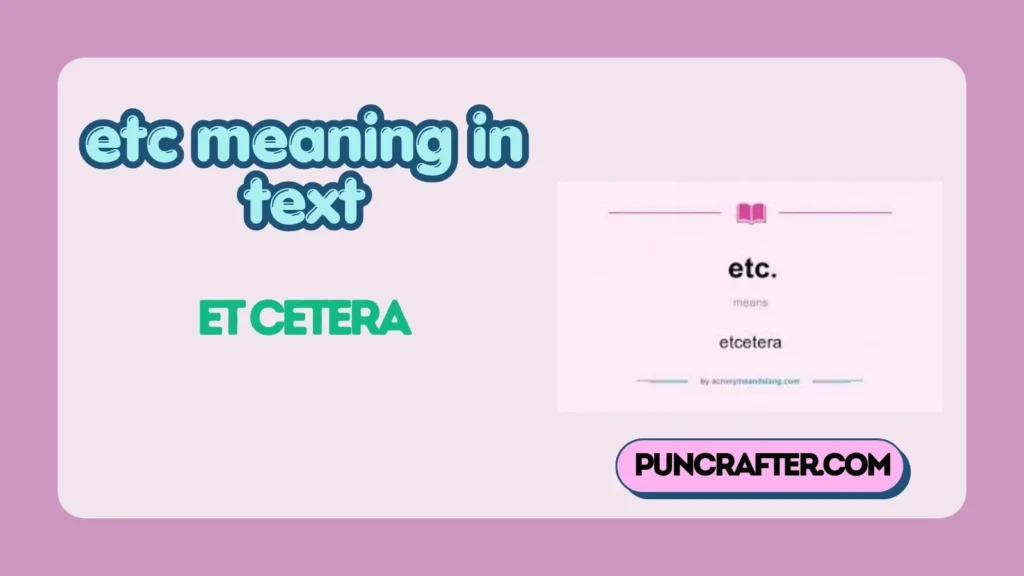
ETC means “et cetera,” a Latin phrase that translates to “and the rest,” “and so on,” or “and other similar things.”
People use ETC when they want to continue a list without mentioning every item individually.
For example:
I need to buy milk, eggs, bread, etc.
The writer is implying there are additional grocery items beyond those listed.
Origin of ETC
The abbreviation ETC comes from the Latin phrase et cetera.
- Et = and
- Cetera = the remaining things
The phrase has been used in English writing for hundreds of years. Long before texting existed, writers used “etc.” to avoid repeating lengthy lists.
As digital communication became faster and more concise, ETC naturally found its place in text messages, emails, forums, and social media posts.
Pronunciation Guide
ETC is usually pronounced in one of two ways:
- “Et cetera”
- Letter by letter: “E-T-C”
Both are widely accepted.
How to Use “ETC” Correctly in Texts & Chat
The primary purpose of ETC is to shorten a list when readers can easily understand what other items belong in that category.
Casual Text Messages
Friends commonly use ETC when discussing plans, hobbies, or shopping.
Example:
Bring snacks, drinks, napkins, etc.
The sender assumes the receiver understands the category of items needed.
WhatsApp Conversations
ETC appears frequently in group chats where people want to save time.
Example:
Everyone bring footballs, cones, water bottles, etc.
Instagram and TikTok
Users often add ETC in captions.
Example:
Summer essentials: sunglasses, sunscreen, beach towels, etc.
Discord and Gaming Chats
Gamers use ETC while discussing equipment, characters, strategies, or updates.
Example:
We need tanks, healers, support players, etc.
Emails
ETC can work in emails, though excessive use may appear vague.
Good:
Please submit receipts, invoices, travel records, etc.
Less effective:
Send all documents, etc.
The second example lacks clarity.
When NOT to Use ETC
Avoid ETC when:
- The exact list matters
- Legal documents require precision
- Instructions must be specific
- Professional reports need completeness
For example:
❌ Submit passport, ID, etc.
Readers may not know what “etc.” includes.
Formatting Tips
Common styles include:
- etc.
- ETC
- etc
Emoji pairings are uncommon, but in casual chats you may see:
- etc 😂
- etc 🤣
- etc 😅
Real Conversation Examples Using “ETC”
Example 1: Between Friends
Alex: What should I bring to the picnic?
Mia: Chips, drinks, cookies, etc.
Meaning: Mia is listing examples while implying additional snack options.
Example 2: Family Group Chat
Dad: What do you want for your birthday?
Emma: Books, art supplies, gift cards, etc.
Meaning: Emma has multiple preferences and doesn’t want to list everything.
Example 3: Dating Conversation
Jordan: What kind of movies do you like?
Taylor: Comedy, action, sci-fi, etc.
Meaning: Taylor enjoys several genres beyond those mentioned.
Example 4: Work Chat
Manager: What should we include in the presentation?
Employee: Sales figures, customer feedback, market trends, etc.
Meaning: Additional relevant business data should also be included.
Example 5: Gaming Server
Player 1: What do we need for the raid?
Player 2: Potions, armor upgrades, healing items, etc.
Meaning: There are other preparation items beyond those listed.
Common Mistakes & Misunderstandings
Even though ETC is simple, people often misuse it.
1. Using ETC After “And”
Incorrect:
We need pens, notebooks, and etc.
Correct:
We need pens, notebooks, etc.
Since “et” already means “and,” adding another “and” is redundant.
2. Using ETC for Unrelated Items
Incorrect:
Bring shoes, pizza, laptop, etc.
These items don’t form a clear category.
Readers may struggle to understand what “etc.” represents.
3. Overusing ETC
Some people rely on ETC too often.
Example:
We discussed marketing, etc.
This sounds vague.
A more specific list is usually better.
Generational Misunderstandings
Older generations generally recognize ETC immediately because it has existed for decades.
Younger users sometimes assume ETC is a newer texting acronym and search for hidden meanings.
Fortunately, the meaning remains consistent across age groups.
Regional Differences
ETC is widely understood in:
- United States
- United Kingdom
- Canada
- Australia
- India
- Pakistan
- Most English-speaking regions
The abbreviation rarely changes meaning internationally.
How to Clarify If Someone Doesn’t Understand
Simply explain:
ETC means “and so on.”
or
ETC means there are more similar items in the list.
Most confusion disappears instantly.
“ETC” Across Different Platforms & Demographics
Gen Z Usage
Gen Z uses ETC frequently but often prefers shorter alternatives like:
- and stuff
- and more
- blah blah
- you know
Still, ETC remains common in captions and comments.
Millennials
Millennials regularly use ETC in:
- Emails
- Text messages
- Workplace chats
- Social media
This generation tends to view it as a standard abbreviation.
Older Generations
Older adults often use ETC in traditional writing because they learned it long before the internet existed.
TikTok
On TikTok, ETC commonly appears in:
- List-style captions
- Recommendations
- Tutorials
- Product reviews
Example:
Things I carry every day: charger, earbuds, wallet, etc.
Instagram users often include ETC in:
- Lifestyle posts
- Travel captions
- Fashion recommendations
Discord
Discord communities use ETC while discussing:
- Game mechanics
- Hardware setups
- Server rules
- Team compositions
Is ETC Safe for Work?
Yes.
Unlike many internet abbreviations, ETC is:
✅ Professional-friendly
✅ School-friendly
✅ Family-friendly
✅ Workplace-appropriate
There is no offensive or hidden meaning attached to it.
Related Slang, Abbreviations & Alternatives
| Term | Meaning |
|---|---|
| LOL | Laughing Out Loud |
| TBH | To Be Honest |
| IMO | In My Opinion |
| FYI | For Your Information |
| BRB | Be Right Back |
| IDK | I Don’t Know |
| AKA | Also Known As |
| NGL | Not Gonna Lie |
| BTW | By The Way |
| TMI | Too Much Information |
Alternatives to ETC
Instead of ETC, people often say:
- And so on
- And more
- And the rest
- You get the idea
- Among others
- And stuff
- And similar things
Synonyms
- And so forth
- And the like
- Among other things
- And more
Casual Opposites
There isn’t a direct antonym, but alternatives include:
- Specifically
- Exactly
- Only
- Precisely
Why Do People Use “Etc.” in Text Messages?
People use “etc.” in texts because it helps shorten messages while still conveying that there are additional items, examples, or ideas that don’t need to be listed individually.
Instead of typing a long list, someone can simply add “etc.” at the end to indicate that similar things continue beyond what has been mentioned. This makes texting faster and keeps messages concise.
For example:
“I need milk, bread, eggs, etc.”
The reader understands there are more grocery items without seeing the entire list.
Is “Etc.” Formal or Informal in Texting?
One reason “etc.” remains popular is its flexibility. It works in both casual and professional communication.
In everyday texting, it helps simplify conversations. In workplace chats or school-related messages, it can also be used appropriately when listing examples.
However, excessive use can make messages vague. In situations where specific details matter, it’s often better to provide the complete information instead of relying on “etc.”
How “Etc.” Saves Time in Digital Communication
Modern messaging emphasizes speed and efficiency. “Etc.” allows users to communicate broader ideas without typing every detail.
Examples include:
- Shopping lists
- Travel plans
- Event preparations
- Study materials
- Work tasks
By reducing unnecessary typing, “etc.” helps conversations move more quickly while preserving meaning.
Common Situations Where “Etc.” Appears in Texts
The abbreviation frequently appears in messages involving lists or examples.
Typical situations include:
- Discussing groceries
- Planning vacations
- Talking about hobbies
- Organizing events
- Sharing recommendations
- Describing responsibilities
Because daily conversations often involve multiple related items, “etc.” naturally fits into many texting scenarios.
What Does It Mean When Someone Ends a Message With “Etc.”?
When “etc.” appears at the end of a sentence, it usually signals that the writer assumes the reader understands the pattern.
For example:
“We talked about movies, music, games, etc.”
The sender is implying there were additional entertainment-related topics discussed.
This use relies on shared understanding between the people communicating.
How “Etc.” Changes the Tone of a Message
Using “etc.” can affect how a message feels.
In some cases, it makes communication more casual and conversational because it avoids unnecessary detail.
In other situations, it can create a sense of informality or even impatience if overused.
For example:
“I’ve already explained the rules, expectations, deadlines, etc.”
This may sound slightly dismissive compared to listing everything explicitly.
The Difference Between “Etc.” and “And So On”
Both expressions serve similar purposes, but they are used slightly differently.
“Etc.” is usually written in lists.
Example:
“Pens, pencils, notebooks, etc.”
“And so on” often appears in complete sentences.
Example:
“We discussed budgeting, saving, investing, and so on.”
Both indicate continuation, but “etc.” tends to be more concise.
Why Some People Avoid Using “Etc.”
Although useful, some writers avoid “etc.” because it can sometimes create ambiguity.
The reader may wonder:
- What else belongs on the list?
- How many additional items are included?
- Are the omitted items important?
In situations requiring precision, providing complete information is often preferable.
How Students Commonly Use “Etc.” in Messages
Students frequently use “etc.” when discussing academic topics.
Examples include:
- Assignment requirements
- Study materials
- Classroom supplies
- Exam preparation
- Project tasks
A student might text:
“Bring calculators, notebooks, rulers, etc.”
The abbreviation keeps the message brief while communicating the general idea.
How Professionals Use “Etc.” in Workplace Chats
In professional messaging platforms, “etc.” can help summarize related tasks or responsibilities.
Examples include:
- Meeting agendas
- Project updates
- Administrative duties
- Planning discussions
However, professionals generally use it carefully because workplace communication often requires clarity and specificity.
Can “Etc.” Be Overused?
Yes. While “etc.” is convenient, excessive use can weaken communication.
Consider this example:
“We need to discuss schedules, deadlines, expectations, goals, etc.”
If every message relies on “etc.,” important details may be overlooked.
Using it strategically improves readability, while overusing it may create confusion.
How “Etc.” Appears on Social Media
Social media users often include “etc.” in captions, comments, and posts when mentioning multiple examples.
Examples:
- Favorite hobbies
- Travel destinations
- Food preferences
- Entertainment interests
A post might read:
“I love hiking, photography, reading, etc.”
This communicates a broader range of interests without creating an overly long caption.
The Historical Origin of “Etc.”
Unlike many modern texting abbreviations, “etc.” has a long history.
It comes from the Latin phrase et cetera, which translates to “and the rest” or “and other similar things.”
The expression existed centuries before smartphones, social media, or text messaging. Its transition into digital communication shows how traditional language adapts to new technologies.
Is “Etc.” Universally Understood?
One reason “etc.” remains widely used is its global recognition.
Many English speakers learn its meaning early in school, making it familiar across age groups and professions.
Even non-native English speakers often recognize “etc.” because it appears frequently in books, websites, educational materials, and everyday communication.
How “Etc.” Helps Keep Messages Organized
Long messages can become difficult to read when every item is listed individually.
Using “etc.” helps streamline communication by:
- Reducing clutter
- Improving readability
- Highlighting key examples
- Keeping conversations concise
This makes it especially useful in mobile messaging, where users often prefer short, easy-to-scan text.
The Future of “Etc.” in Digital Language
While internet slang changes rapidly, “etc.” has demonstrated remarkable staying power.
Its meaning is clear, its purpose is practical, and it works across formal and informal communication styles.
FAQs:
What does ETC mean in texting?
ETC stands for “et cetera,” meaning “and so on” or “and other similar things.” People use it to shorten lists and avoid typing every item individually.
Is ETC internet slang?
No. ETC predates the internet by centuries. It comes from Latin and has long been used in books, letters, academic writing, and business communication.
Should ETC have a period?
Traditionally, yes. The correct written form is “etc.” However, many people omit the period in casual texting.
Is ETC rude?
No. ETC is generally neutral and polite. Problems only arise when it makes instructions too vague or unclear.
Can I use ETC in professional communication?
Yes. ETC is acceptable in many workplace settings. However, avoid it when detailed or precise information is required.
Why do people use ETC instead of listing everything?
ETC saves time and space. It helps writers avoid repeating obvious information while keeping messages concise and easy to read.
Conclusion:
Understanding ETC meaning in text is surprisingly straightforward. Unlike many modern internet abbreviations ETC isn’t trendy slang or a secret code. It’s simply a shortened form of et cetera, meaning and so on.
You’ll see ETC everywhere from text messages and WhatsApp chats to emails Discord servers, Instagram captions, and workplace conversations. Its popularity comes from one simple benefit: it makes communication faster.
The next time someone writes books movies games etc. you’ll know exactly what they mean.

Hi, I’m Lina Roys, the writer behind Puncrafter, where I shape simple words into clever lines that spark instant smiles.I write with heart and humor, crafting puns that feel light, warm, and impossible to scroll past.