Have you ever sent a long message and received nothing but a single letter in return?
Just K.
That tiny response can trigger a surprising amount of confusion. Is the person simply saying okay Are they annoyed Did you do something wrong Or are they just in a hurry
The k meaning in text has become one of the most searched texting questions because context changes everything. While K is technically a shortened version of OK its emotional meaning can vary dramatically depending on who sends it, where it’s used, and the conversation surrounding it.
In today’s fast-paced world of texting WhatsApp messages Instagram DMs Discord chats and social media comments understanding digital communication matters more than ever.
Updated for 2026 this guide explains exactly what K means how people use it when it can sound rude and how to interpret it correctly in real-life conversations.
What Does “K” Mean?
Quick Answer
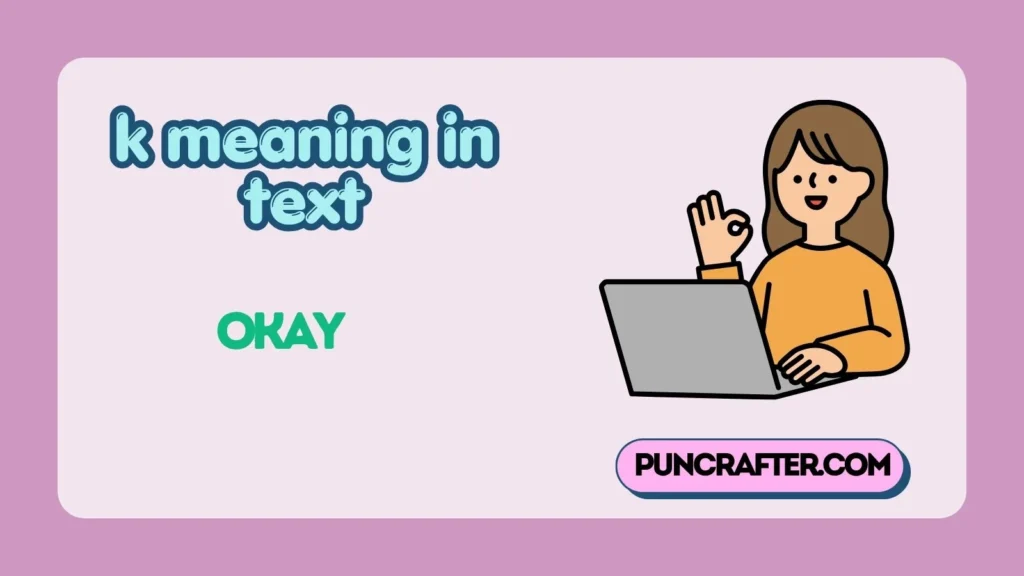
K means “okay” or “OK.” It is a shortened acknowledgment used in text messages, online chats, and social media conversations. Depending on context, it can sound friendly, neutral, dismissive, or annoyed.
Simple Definition
The letter “K” is one of the shortest responses in digital communication. Most commonly, it means:
- Okay
- I understand
- Got it
- Message received
- Agreement
For example:
Person A: “I’ll be there at 6 PM.”
Person B: “K”
Here, the response simply means “Okay.”
Origin of K
The abbreviation comes from “OK,” which has been widely used for over a century. As texting became popular in the late 1990s and early 2000s, users began shortening common words to save time and character limits.
Eventually:
- Okay → OK
- OK → K
The rise of SMS messaging, instant messaging apps, and social media accelerated its use.
How the Meaning Evolved
Originally, K was merely a faster way to type OK.
Over time, people began attaching emotional meaning to it.
Today, a single “K” can sometimes signal:
- Disinterest
- Frustration
- Sarcasm
- Passive-aggressiveness
- Lack of enthusiasm
That’s why context matters.
Pronunciation
“K” is pronounced simply as:
“Kay”
How to Use “K” Correctly in Texts & Chat
Understanding when to use K can save you from awkward misunderstandings.
Appropriate Situations
Use K when:
- A response doesn’t require detail
- You’re acknowledging information
- You’re in a casual conversation
- You’re texting close friends
Examples:
- “Meeting starts at 2.”
- “K”
- “Don’t forget your keys.”
- “K”
Tone and Context
The same letter can communicate different emotions.
Neutral
“K”
Simple acknowledgment.
Friendly
“K 😊”
Adds warmth.
Enthusiastic
“K! Sounds good!”
More positive.
Irritated
“K.”
A period after K can sometimes make it feel colder.
Platform-Specific Usage
SMS/Text Messages
Very common for quick confirmations.
Often used among family and friends.
Instagram DMs
Less common by itself. People usually add emojis or extra words.
X (Twitter)
Frequently used in replies and casual conversations.
Discord
Often appears in gaming chats where speed matters.
Can be used sarcastically or dismissively depending on the discussion.
When NOT to Use K
Avoid using K when:
- Sending professional messages
- Talking to clients
- Responding to important emotional conversations
- Communicating with someone who may misinterpret your tone
Instead of:
“K”
Consider:
“Okay, thanks!”
or
“Got it.”
Real Conversation Examples Using “K”
Example 1: Between Friends
Alex: “Movie starts at 8.”
Jordan: “K”
Meaning: Quick acknowledgment. No negative emotion implied.
Example 2: Family Chat
Mom: “Don’t forget to buy milk.”
You: “K 👍”
Meaning: Agreement plus friendliness.
Example 3: Dating Conversation
Taylor: “I think we need to talk later.”
Chris: “K”
Meaning: Potentially concerning. The short response may seem distant or upset.
Example 4: Work Chat
Manager: “Can you send the report by noon?”
Employee: “Okay, I’ll send it before noon.”
Meaning: Notice how K would feel too informal here.
Example 5: Gaming Chat
Teammate: “Push left side.”
Player: “K”
Meaning: Fast acknowledgment during gameplay.
Common Mistakes & Misunderstandings
1. Assuming K Always Means Anger
One of the biggest misconceptions is believing K automatically means someone is upset.
In reality, many people simply type quickly and prefer short responses.
2. Ignoring Relationship Context
A best friend sending “K” usually feels normal.
A romantic partner suddenly replying only with “K” after an argument may signal frustration.
Context changes everything.
3. Confusing K with OK
Although they share the same basic meaning, they don’t always feel the same emotionally.
| Response | Typical Tone |
|---|---|
| Okay | Friendly |
| OK | Neutral |
| K | Brief or potentially cold |
Generational Differences
Older generations often view K as a simple abbreviation.
Many younger users, especially Gen Z, sometimes interpret it as:
- Distant
- Dry
- Uninterested
This difference creates misunderstandings surprisingly often.
How to Clarify
If you’re unsure what someone means, ask politely.
Example:
“Everything okay? Your reply seemed a little short.”
This avoids assumptions.
K Across Different Platforms & Demographics
Gen Z Usage
Gen Z tends to read more emotional meaning into short texts.
A standalone K may be viewed as:
- Dry texting
- Lack of enthusiasm
- Mild annoyance
Millennials
Millennials often use K casually but understand its potential for misinterpretation.
Older Generations
Many older users see K simply as a shortcut for okay.
They may not realize younger people sometimes view it negatively.
TikTok
TikTok creators frequently joke about receiving “K” after sending long messages.
The one-letter response has become a popular meme.
People often soften K by adding:
- Emojis
- GIFs
- Additional words
Examples:
- “K 😊”
- “K lol”
- “K sounds good”
Discord & Gaming Communities
Speed matters, so K is generally interpreted as a neutral acknowledgment.
Is K Safe for Work?
Technically yes.
However, it’s not ideal for professional communication because it can appear abrupt.
Use:
- Okay
- Sounds good
- Understood
- Thanks
instead.
Related Slang Abbreviations & Alternatives
Here are common terms related to K.
| Term | Meaning |
| OK | Standard form of okay |
| KK | Extra-friendly version of K |
| Kk | Casual acknowledgment |
| Gotcha | I understand |
| Roger | Message received |
| Yep | Yes |
| Yup | Informal yes |
| Alright | Agreement |
| Sounds good | Positive acknowledgment |
| Sure | Acceptance or agreement |
Similar Expressions
- OK
- Alright
- Got it
- Understood
- Sounds good
- Will do
Opposite Expressions
- No
- Nope
- Not okay
- Disagree
- Pass
You may also want to learn more about:
- LOL meaning in text
- SMH meaning in text
- IMO meaning in text
- TBH meaning in text
- WYD meaning in text
These abbreviations frequently appear alongside K in modern conversations.
What Does It Mean When Someone Replies Only “K”?
A reply containing only “K” is usually a form of acknowledgment. However, the exact meaning depends on the conversation. In some cases, it simply means “message received.” In others, it may indicate that the person doesn’t want to continue the discussion.
For example:
- “I’ll pick you up at 7.” → “K” (Acknowledgment)
- “Why are you ignoring me?” → “K” (Possibly frustration or avoidance)
Instead of focusing solely on the letter, consider the context, previous messages, and the sender’s typical texting habits.
When “K” Is a Positive Response
Many people assume K is negative, but that’s not always true. In fast-paced conversations, K can be a perfectly positive response.
Common positive uses include:
- Confirming plans
- Accepting invitations
- Acknowledging instructions
- Agreeing with suggestions
Examples:
- “Want to grab pizza later?” → “K!”
- “Meet me at the entrance.” → “K 👍”
Adding punctuation, emojis, or enthusiasm can make the response feel friendlier.
Signs That “K” Might Indicate Annoyance
While K doesn’t automatically mean someone is upset, certain clues can suggest irritation.
Watch for these signs:
- The conversation was already tense.
- They suddenly switched from long replies to “K.”
- They stop asking questions.
- They use “K.” with a period repeatedly.
Example:
Before argument:
“That sounds awesome!”
After argument:
“K”
In situations like these, the response may reflect frustration rather than simple acknowledgment.
How “K” Changed Digital Communication
The rise of abbreviations transformed how people communicate online. K became one of the earliest examples of extreme text shortening.
Benefits of using K include:
- Faster typing
- Quick responses
- Efficient communication
- Reduced effort during busy moments
As messaging apps evolved, K became part of internet culture and remains one of the most recognized abbreviations worldwide.
K in Group Chats vs Private Messages
The meaning of K can vary depending on where it appears.
In Group Chats
K is often viewed as a quick acknowledgment.
Example:
Group Admin: “Meeting starts at 9.”
Member: “K”
Nobody typically reads much emotion into it.
In Private Messages
People tend to analyze the response more carefully because personal conversations carry more emotional weight.
The same letter may feel significantly different in a one-on-one chat.
How Emojis Change the Meaning of K
Emojis can completely transform how K is interpreted.
Examples:
| Message | Possible Meaning |
|---|---|
| K | Neutral |
| K 😊 | Friendly |
| K 👍 | Agreement |
| K 😂 | Playful |
| K ❤️ | Affectionate |
| K 😒 | Annoyed |
Because text lacks facial expressions, emojis help communicate tone more clearly.
Why People Overthink the Letter K
Digital communication leaves room for interpretation. Without vocal tone or body language, people often read between the lines.
Reasons people overanalyze K:
- Fear of conflict
- Relationship uncertainty
- Previous negative experiences
- Social media culture
In many cases, the sender may have intended nothing beyond a simple “okay.”
Understanding this can reduce unnecessary anxiety during conversations.
K in Online Gaming Culture
Gamers frequently use K because speed matters during gameplay.
Common examples include:
- “Defend the base.” → “K”
- “Meet at checkpoint B.” → “K”
- “Ready?” → “K”
In gaming communities, K is usually interpreted as efficient communication rather than an emotional statement.
This differs from personal texting, where tone is often scrutinized more closely.
How Businesses and Brands Use K on Social Media
Some brands intentionally use casual language to appear relatable.
However, most professional social media managers avoid replying with only K because it can seem dismissive.
Instead, brands often choose responses such as:
- “Okay!”
- “Sounds good!”
- “Got it, thanks!”
- “We’ll look into it.”
Customer communication generally benefits from a warmer tone than personal texting.
Fun Facts About the Letter K in Internet Slang
The popularity of K has created several interesting slang variations.
Examples include:
KK
Means “okay, okay” and usually sounds friendlier.
KKK
In texting, this should generally be avoided because it has unrelated historical associations.
Mkay
A playful version of “okay” often used humorously.
Oki
A cute or informal alternative commonly used in friendly chats.
These variations show how internet users continually adapt simple words to create new communication styles.
How Parents Can Understand “K” in Their Teen’s Messages
Parents often worry when they receive a short response from their children.
In most cases, K simply means:
- I saw your message.
- I understand.
- I’m busy right now.
It does not automatically indicate anger or disrespect.
Instead of assuming the worst, parents should look at the broader conversation and the teenager’s normal communication patterns.
FAQs:
What does K mean from a girl?
Usually it simply means “okay.” However, context matters. If the conversation was emotional or tense, some people may use K to express annoyance, disappointment, or a desire to end the discussion.
What does K mean from a guy?
The meaning is generally the same. Most often it means okay, understood, or message received. Personality and communication style matter more than gender.
Is K passive-aggressive?
Sometimes. A single-letter response after a disagreement may feel passive-aggressive. In ordinary conversations, though, K is often just a quick acknowledgment.
Why do people use K instead of OK?
Convenience. K is faster to type and has become a common texting habit. Many users choose it simply because it’s efficient.
Is K rude in professional communication?
It can appear abrupt or dismissive in workplace settings. Writing “Okay,” “Understood,” or “Sounds good” usually creates a more professional impression.
What does KK mean in text?
KK generally means “okay, okay.” It often sounds friendlier and warmer than a single K.
Does K end a conversation?
Often yes. Because it acknowledges a message without adding new information, K can naturally signal the end of a conversation.
Conclusion:
The K meaning in text is simple on the surface: it usually means okay.
The tricky part is tone. Depending on context, relationship dynamics, and platform culture, K can feel friendly neutral rushed annoyed or even passive aggressive.
When in doubt, look at the entire conversation rather than one letter. Most of the time, K is just a quick acknowledgment not a hidden message.
Got a favorite text abbreviation or internet slang term Drop it in the comments below and keep exploring the fascinating world of digital communication!

Hi, I’m Lina Roys, the writer behind Puncrafter, where I shape simple words into clever lines that spark instant smiles.I write with heart and humor, crafting puns that feel light, warm, and impossible to scroll past.